Prodefy
- 0.0
- Rating
- 10.00K
- Installs
- Free
- Price

 Analysis by App-foxy
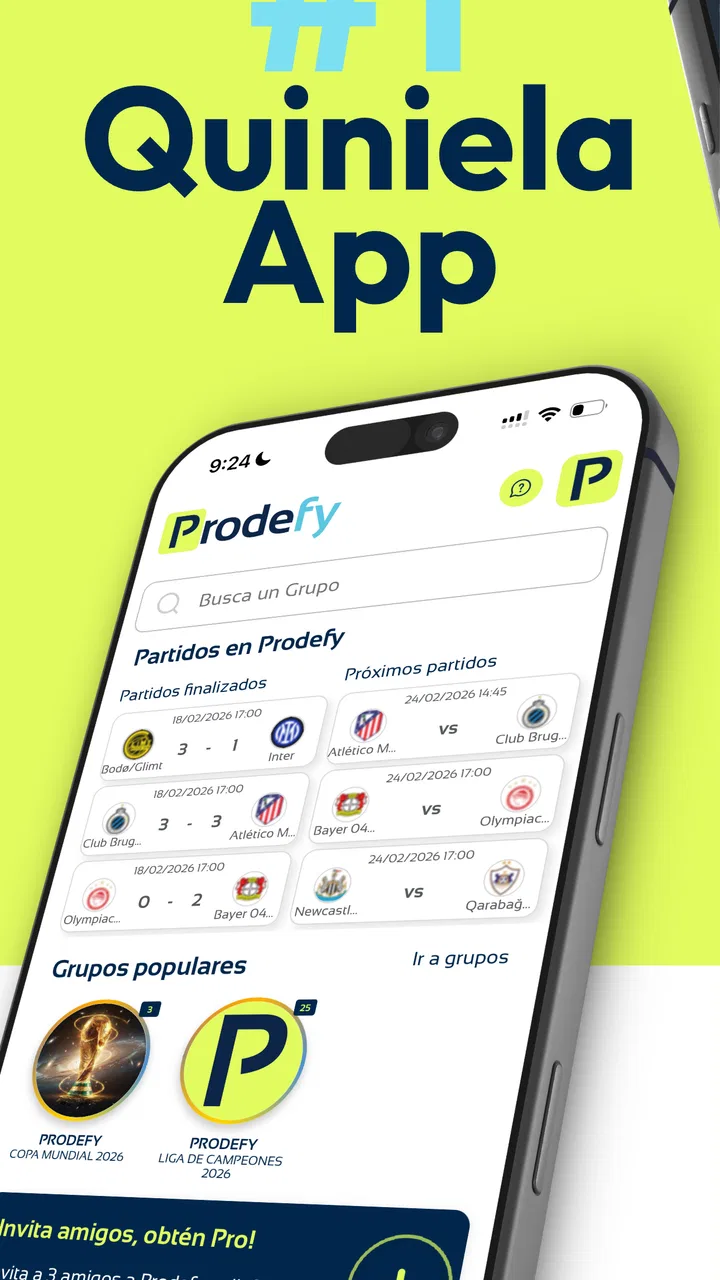
Following a tournament bracket is easy when everyone is watching the same match, but running a prediction pool among friends can become surprisingly messy. I tried Prodefy as a sports app built around that exact social habit: choosing results, checking a World Cup bracket, and giving a group of friends one shared place to make their predictions. Its idea is focused rather than broad, which is useful if you want a lightweight pool instead of a full sports-news platform.
What stood out to me first was how much the experience depends on the people using it. This is not an app I would open for live scores, player profiles, training plans, or general sports coverage. Its value appears when a group agrees to use the same bracket and keeps returning to it. If that sounds like your situation, the app has a clear purpose. If you are looking for a complete football companion, it may feel narrow.
How the bracket experience feels to use
I focus here on the bracket itself: how a tournament layout can turn separate score guesses into one shared activity. In practice, I find the useful question is not only whether each prediction is easy to enter, but whether everyone can understand how their choices fit together. That becomes especially important once friends start comparing their picks.
You May Also Like

 AccuWeather: Weather Radar
AccuWeather Review: A Quick, Clear Forecast for Everyday Decisions
For everyday plans, the best forecast is the one you can understand quickly. AccuWeather makes rain timing, radar, and local conditions easy to act on, with a few trade-offs.

 Hill Climb Racing
Why Hill Climb Racing Still Turns Crashes Into One More Run
A tiny car, a bumpy hill and one more upgrade: Hill Climb Racing keeps resurfacing because its simple chaos makes every near-miss feel personal.

 AliExpress - Shopping App
AliExpress Makes Global Shopping Feel Personal, but Shoppers Bear the Risk
AliExpress turns a global marketplace into a pocket-sized discovery engine. Its reach is useful, its shopping loop compelling, and its trade-offs easy to miss.

 Lords Mobile: Kingdom Wars
Lords Mobile Is a Kingdom-Building Routine, Not a Quick Match
A case-by-case verdict on the building, battles, device demands, and social commitments that make Lords Mobile rewarding for some players and exhausting for others.

 PDF Scanner app - TapScanner
TapScanner Makes Paperwork Easier to Capture, Check, and Share
TapScanner makes scanning with a phone feel less like a rescue operation and more like a dependable step in getting work done. Its capture tools are useful, though not flawless.

 Block Blast!
 Shows How Much a Puzzle Game Can Leave Out
A quiet grid game shows why puzzle players increasingly value instant clarity, repeatable skill and low-pressure play—and where the genre still needs to catch up.
More From Our News Desk
View All News


Readable navigation for a quick group setup
The most important part of this kind of app is not visual decoration; it is whether I can understand the bracket without stopping to figure out what each screen expects from me. Prodefy presents itself as a prediction tool, so the natural workflow is to move from the competition structure to score choices and then to the pool shared with friends. That straightforward mental model is a strength for casual users who do not want to learn a complicated fantasy-sports system.
I found the bracket concept easier to approach than a large sports app filled with news cards, alerts, standings, and unrelated competitions. A focused interface can reduce the amount of scanning needed, especially when I only want to make a prediction and leave. The trade-off is that a compact app may offer less explanation around each action. New users should take a moment to check whether a selection has been saved and whether they are viewing their own predictions or the group’s shared pool.
That distinction matters in a social contest. A good habit is to make predictions in one deliberate pass, then review the complete bracket before inviting friends or treating the entry as final. I would not rely on memory alone, particularly if the app places several decisions close together. A final review helps catch the common mistake of tapping through a screen quickly and assuming every score was recorded.
The developer, Saga Group, has kept the product’s identity tied to the World Cup bracket rather than trying to turn it into an all-purpose sports service. I appreciate that restraint. It gives the app a recognizable job, although it also means the usefulness depends heavily on whether the relevant competition is the one your group wants to follow.
Making predictions without turning them into homework
Predicting scores is more engaging than simply choosing a winner because it gives friends something specific to debate. I can imagine using the app before a matchday, entering a score based on recent form or personal instinct, and then comparing choices with the rest of the pool. The social value comes from the ritual: everyone commits to an answer, and the bracket gives the conversation a shared reference point.
My practical advice is to establish the rules with your group before anyone starts. Decide whether people are making one complete bracket, whether late changes are allowed, and when predictions should be considered closed. Those rules are not a substitute for app functionality, but agreeing on them prevents arguments later. A prediction app works best when the technology supports a clear group routine rather than trying to resolve every disagreement after the fact.
Another useful workflow is to use a single organizer as the person who creates or coordinates the pool, while everyone else joins and checks their own entry. That reduces duplicated groups with similar names and makes it easier to know where the official competition is happening. For a family, workplace, or small friend group, that simple structure is likely more comfortable than asking every participant to experiment independently.
Who will find the interface approachable
Because Prodefy is free to download and aimed at Everyone, it is approachable for a broad audience in principle. I would especially recommend trying it for people who want a casual prediction activity without committing to a season-long fantasy game. Someone who understands a tournament bracket should be able to grasp the basic purpose quickly, while newcomers may benefit from having a friend explain the scoring expectations before they begin.
The app has reached over ten thousand installs, but its average rating currently sits at zero. I would treat that combination as a reason to keep expectations measured, not as a definitive judgment of the product. It suggests that the public feedback picture is not yet useful for making a decision on its own. In practice, I would test the basic bracket flow with the intended group before relying on it for a large event.
Motor and sensory considerations during entry
Prediction entry is an interaction where small design choices can have an outsized effect. A user who has limited dexterity, hand tremors, or difficulty with precise tapping may find repeated score selection tiring if controls are compact or if the app requires many quick adjustments. I cannot assume that every control is comfortable for every hand, so I would recommend entering predictions when there is time to pause and review rather than rushing just before a match.
For users with low vision, the bracket may be more demanding than a simple list because tournament structures can place information across a wider visual area. Increasing the device’s text size or display scaling may help in some parts of the experience, but enlarged system text can also create crowding if the layout is not flexible. The safest approach is to inspect the bracket on the actual phone that will be used and confirm that team names, score fields, and confirmation states remain easy to distinguish.
Color perception is another practical consideration. Brackets often use lines, highlights, or status colors to show progress, selection, or advancement. I would not assume that color alone communicates the meaning of a state. If a selected prediction is indicated mainly by a tint or subtle shade, someone with color-vision differences may need an additional cue such as a visible mark, changed text, or clear position. Before sharing the pool widely, I would ask participants whether they can tell which choices are active and which are still waiting for input.
For people sensitive to motion, animation, or visual clutter, a focused bracket can be preferable to a busy sports feed, but the actual comfort will depend on how transitions are presented on the device. Using the phone’s system settings for reduced motion, larger text, or stronger contrast is sensible where supported. These adjustments improve the surrounding device experience, though they cannot guarantee that every part of Prodefy will respond perfectly.
Audio, language, and shared decision-making
A score-prediction app is usually used visually, which can create a barrier for someone who depends on a screen reader or prefers spoken guidance. I would test whether labels, buttons, and selected states are announced in a logical order before asking a screen-reader user to complete a full bracket. A screen reader may handle a simple list comfortably but struggle with a dense tournament layout if relationships between rounds are not exposed clearly.
There is also a social workaround worth considering: one person can act as the group’s entry assistant while the participant makes every decision verbally. That preserves the person’s involvement, but it should be treated as a choice rather than an obligation. The participant should be able to review what was entered and correct mistakes. This shared workflow is useful for someone who finds the visual layout difficult, but it is less private and less convenient than independent access.
People who are not confident with football terminology may need extra context from the group. Prodefy’s narrow purpose does not automatically explain tournament rules, tie situations, or how a pool interprets exact scores. I would pair the app with a short plain-language explanation before the first entry. That makes the activity more welcoming for casual fans and avoids making knowledge of bracket conventions a hidden requirement.
Using the app in everyday situations
A realistic use case is a group of coworkers who want a low-effort World Cup activity without installing a full fantasy platform. One organizer can introduce the pool, everyone can enter predictions during a lunch break, and the group can discuss the bracket in a chat or at work. In that setting, Prodefy’s focused purpose is helpful because nobody needs to learn player statistics, manage a roster, or follow a large content feed.
Another scenario is a family spread across different locations. Each person can make a prediction from their own phone, then use the shared pool as a reason to keep in touch during the tournament. The app does not replace the conversation; it gives the conversation a common structure. That is an important distinction, because the experience will feel empty if nobody checks the pool or talks about the results afterward.
Situational access also includes the environment. Entering a full bracket on a crowded train, in bright sunlight, or while carrying shopping is more error-prone than doing it at home. Small targets, glare, notifications, and one-handed use can all make careful selection harder. I would prepare predictions in a calm setting, rotate the phone if the layout benefits from it, and avoid making last-second edits when attention is divided.
For users with inconsistent internet access, the key question is whether the app allows a complete prediction workflow when connectivity is interrupted. I would not plan an important pool around an assumed offline mode. Instead, complete the entry while connected and verify that the pool reflects it. This is a general reliability precaution, but it matters more when a group has a deadline and one person’s missing entry affects the shared activity.
Where Prodefy sits beside familiar alternatives
The usual alternative is a general sports app. Those services are better when I want news, live match information, standings, alerts, and broader competition coverage in one place. They may also be more familiar to people who already use them every day. Prodefy makes more sense when the bracket and friend-based prediction are the center of attention, not one small feature among many.
A second alternative is a spreadsheet or a group chat. A spreadsheet gives an organizer complete control over columns, scoring, and custom rules, while a chat is excellent for banter and quick reminders. Both can become awkward when several people edit entries, when the bracket changes, or when nobody knows which version is current. Prodefy’s appeal is that it gives the prediction activity a dedicated home instead of forcing the group to build one.
Dedicated fantasy-sports platforms are another comparison point. They are often better for users who want ongoing management, player selection, detailed statistics, and a deeper competitive system. I would choose Prodefy over them for a short, score-focused pool with friends, but not for a season-long hobby that depends on transfers, analysis, or complex strategy. The simpler option is not automatically the better option; it depends on how much structure your group actually wants.
Remaining barriers and practical friction
The biggest limitation is the narrowness of the experience. If my friends are not interested in a World Cup bracket, there is little reason for me to keep the app installed. It is not a general sports utility, and I would not choose it as my only football app. That focus is understandable, but it makes adoption fragile: the group needs a shared event and enough enthusiasm to keep using the pool.
In-app purchases range from four dollars and ninety-nine cents to forty-nine dollars and ninety-nine cents per item, even though the app itself is free. Before joining a pool, I would check which parts of the experience require payment and whether every participant needs the same access. A free starting point is convenient, but a group activity becomes confusing if some people assume all features are included while others encounter a purchase prompt.
The current version is 0.1.7, which gives me the impression of a product still early in its development rather than a mature sports platform. That is not automatically negative: early apps can be pleasantly focused and may improve quickly. It does mean I would be more careful about depending on it for a large public competition, especially if accessibility, account recovery, or pool administration is essential to the event.
Compatibility begins with Android 7.0 or later, which covers many older devices but still makes the phone’s software version worth checking before inviting a group. For an inclusive pool, the organizer should not assume that everyone has a recent handset or a large screen. Test the complete journey on the oldest supported device in the group, including joining, entering a score, reviewing the bracket, and correcting an accidental selection.
My inclusive verdict
I see Prodefy as a promisingly focused option for friends who want to turn a World Cup bracket into a shared prediction game. Its strongest quality is its clear purpose: it can replace a scattered spreadsheet-and-chat arrangement with a dedicated place for predictions. The best audience is a small group that values an easy social ritual more than detailed football analysis or a full fantasy system.
From an inclusion perspective, I would recommend a short trial before organizing a large pool. Check text size, contrast, selection feedback, screen-reader order, one-handed use, and the visibility of the complete bracket on each participant’s phone. These checks are especially important because accessibility is not just about whether an app opens; it is about whether every person can understand, complete, review, and correct the same task.
I would skip it if you need a comprehensive sports hub, advanced fantasy mechanics, or a thoroughly established public track record. I would also avoid making it the sole source of truth for a high-stakes competition until the group has tested its workflow and agreed on rules. For a casual, friendly contest, however, the focused design may be exactly what keeps the activity manageable.
My recommendation is therefore conditional but positive: try Prodefy with a small group, establish the pool rules in plain language, and ask participants what adjustments or assistance they need before predictions begin. The app works best when its simple bracket is paired with thoughtful group organization. Used that way, it can make match predictions more engaging without demanding the complexity of a full sports platform.
FAQs for Prodefy
01What is Prodefy and how does it work?
Prodefy is a fitness app designed to help users achieve their workout goals through personalized training plans and expert guidance. It offers a variety of workouts, from strength training to cardio, tailored to your fitness level. The app utilizes AI to adjust plans based on your progress, ensuring you stay on track.
02Is Prodefy suitable for beginners?
Yes, Prodefy is designed to cater to all fitness levels, including beginners. The app provides step-by-step instructions, video demonstrations, and customizable workout plans to ensure a smooth start. Beginners can gradually increase their intensity as they become more comfortable with the exercises.
03Does Prodefy require a gym membership?
No, Prodefy does not require a gym membership. The app offers a variety of home-based workouts that use minimal equipment, making it accessible for those who prefer working out at home. However, users who have gym access can also find suitable plans that incorporate gym equipment.
04Are there any subscription fees for using Prodefy?
Prodefy offers a free version with basic features, but there is also a premium subscription available. The premium version provides access to advanced features such as personalized meal plans, in-depth performance analytics, and exclusive workout content. Subscription fees vary depending on the plan chosen.
05How does Prodefy track progress and motivate users?
Prodefy tracks progress through integrated fitness metrics and performance analytics. Users can set goals and monitor their improvements over time. The app also includes motivational features like achievements, badges, and community challenges to keep users engaged and motivated on their fitness journey.
Pros
- User-friendly interface and easy navigation.
- Comprehensive workout plans available.
- Real-time progress tracking features.
- Integrates with wearable devices smoothly.
- Customizable alerts and reminders.
Cons
- Limited offline access to features.
- Some features behind a paywall.
- Occasional bugs in latest update.
- Requires constant internet connection.
- Limited social interaction features.

Prodefy
Gallery